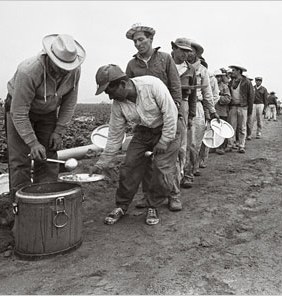
There has finally been a preliminary settlement in the case of the Mexican braceros denied wages earned as guest workers in the U.S. in World War II. Surviving workers, and heirs of the deceased, living in the U.S. will now be eligible to collect $3,500 each.

The braceros case has served for many years as a prominent example of the struggle to obtain justice for old wrongs, and there are strong parallels to the fight for reparations for slavery.

From 1942 to 1946, hundreds of thousands of Mexicans served as guest workers in the U.S., laboring on farms or as railroad workers for about 50 cents an hour. Ten percent of their wages was deducted and sent to the Mexican government, to be given to the braceros upon their return home. Many of the workers never received that money, and have been fighting for their lost wages ever since.

The settlement comes as the result of a class-action lawsuit filed in California in 2001, and the case raised several of the same legal issues as reparations for slavery. Many of the workers had been unable to read their contracts to know that they were owed wages, or were too intimidated to seek wages from the Mexican government at the time. As a result, the case was initially dismissed on the grounds that too much time had passed for a legal remedy. The lawsuit was initially filed against three defendants, the Mexican government, the U.S. government, and Wells Fargo Bank, but only the Mexican government was considered to have legal responsibility for the lost wages.

Former braceros, or their heirs, must be able to provide sufficient documentation of their eligibility.

26 Responses to “Mexican braceros to receive compensation”


  1. Maria Guadalupe Ramirez says:

    Maria Guadalupe Ramirez is my mother. Her father, my grandfather,Jose Maira Ramirez Barajas worked as a bracero since 1944 in Chicago. My mother heard in the radio that the youngest daughter or son could recieve inheritance money. I have no clue if im in the right website..please help if possible.
    Thank You,
    Viridiana Aviles


  2. bobbo says:

    Well Ms Aviles–read the linked story and get in touch with people who can get you in touch with the attorney for the class action–a Mr. Joshua Karsh?

    The story also says the bracero needed to return to Mexico to be qualified to receive any money. Sounds like you might not be qualified==but you easily could be==so get in touch and find out. Time is limited.

    This case is as much “Breach of Contract” as it is Reparations. Of course, anyone who does work and doesn’t get paid should sue and win. When a whole group like this is similarly affect, and the US Government is tangentially involved, every reason to get involved and make sure all of the money gets dispursed as correctly as possible.

    Not much precedent for a reparations analysis.


  3. James says:

    Bobbo, you’re right that the braceros case is not a perfect analogy to reparations for slavery and racial discrimination.

    Where I believe this dispute differed from a standard breach-of-contract case was in the relationship of the parties involved. The Mexican government withheld the portion of their wages which was at issue, which left the workers unable to pursue a claim against their employers or other entities in the United States. Thus while it was a simple case in terms of suing for money owed, it was not as easy as claiming wages owed from an employer.

    I think the key points of analogy between compensation for the braceros and reparations for slavery and discrimination would be: (1) that any claim would have to be pursued against governments, not private parties; (2) that complicity for wrongdoing was spread widely among many parties; (3) that compensation occurs long after legal action could ordinarily be pursued, because of barriers which existed to legal action at the time; (4) that where the original victims are no longer alive, their descendants are eligible to collection their compensation.

    I haven’t heard from Viridiana since December, so I have no update on whether her mother was able to pursue compensation.


  4. bobbo says:

    (2) that complicity for wrongdoing was spread widely among many parties; /// No. Just the Mexican Government and the braceros who RETURNED HOME to Mexico (truly an unknown number?).

    (4) that where the original victims are no longer alive, their descendants are eligible to collection their compensation. /// Mostly right but it is common for family/wives and children to inherit certain causes of action for deceased husbands/fathers. Breach of Contract is one such action. I assume many reparations schemes don’t get into the weeds about any such directly qualifying factors?

    If she checked the request for email notification maybe she can tell us–if she didn’t check it, you could send a courtesy notice?? Lack of paperwork proof can be very disheartening, and I’m sure that a few bracero families who never went back to Mexico will “feel” they deserve the extra money anyway. Feelings are like that.


  5. James says:

    On the widespread nature of the complicity, bobbo, responsibility was arguably spread among the Mexican and U.S. governments, as well as the workers themselves and the various agencies and employers involved. None of these parties was entirely innocent in how these workers were treated, and why they didn’t receive their wages as promised.

    On deceased victims, it is not common for spouses or children to inherit legal causes of action. You may be thinking of the right of a deceased person’s estate to pursue legal action in certain situations.

    To the extent that there is legal precedent for children to pursue legal remedies on behalf of their deceased parents, this would only strengthen the case of reparations advocates. Once the door is open to paying people for wrongs done to a dead ancestor, the difference between children and more distant descendants becomes merely a matter of degree, or of demonstrating continuing harm.

    Most reparations proposals don’t get into these issues, bobbo, because most don’t propose lawsuits, but rather political solutions.

    As to Mexican braceros or their families who didn’t return to Mexico and who you say now “feel” that they deserve the “extra” money, could we rephrase that? Is there any reason not to say that they do deserve that money, which isn’t “extra” but rather the wages to which they were entitled all along (regardless of who, under the settlement, may actually collect)?

    In other words, I don’t see how this is primarily a matter of feelings at all.


  6. bobbo says:

    James–what did the US government do that was wrong? Its not mentioned in the article. The US government paid a % of wages due the Braceros to the Mexican government to be paid to Braceros filing claims on same IN MEXICO with their own government. I don’t see any complicity unless the money wasn’t paid by the USA to Mexico?

    Yes, I’m exactly thinking of the deceased persons estate gaining most/many causes of action. In most/many estates, its the surviving family members who serve as Administrators of those estates or who direct the Administrators. These causes of action do have time frames that still need to be followed thereby excluding grandchildren from normally participating in these DIRECT ACTION lawsuits. If this strengthens reparations actions thats fine with me.

    We haven’t defined reparations actions yet. What is given, and who gets it, under what conditions. Everyone that has a legal effective direct action lawsuit would have no need for reparations and would therefore be excluded I would think. You can’t be damaged if you have been made whole?

    If one term of qualifying for the withheld wages was to return to Mexico and file a claim there, how in the world could staying in America, NOT going to Mexico, and NOT filing a claim qualify/entitle said person to payment? If you want to void the contract and substitute an entirely different set of benefits==thats a different issue and not a contractual recovery.

    The desired result of getting paid when all the conditions weren’t met doesn’t come from “thinking” so feelings was all I had left. What are my other choices?


  7. James says:

    what did the US government do that was wrong?

    Let’s see … the U.S. government negotiated an agreement with the Mexican government to have 10% of the workers’ wages sent to Mexico, to be distributed to the workers there. The U.S. government then oversaw a system in this country in which the braceros were required to sign contracts in a language most of them couldn’t read, so that they didn’t even know wages were being withheld or how to receive them later. Then, when these facts were brought to the government’s attention, the workers were put off or dismissed rather than being aided in receiving what they were entitled to.

    Is the U.S. solely responsible? Absolutely not. Does it bear a measure of responsibility, for knowing what happened, for having helped to make that possible, and for having done nothing to correct the situation, given that the workers were toiling for the benefit of this country? That would be my opinion, yes.

    I’m exactly thinking of the deceased persons estate gaining most/many causes of action.

    All right, but that’s very different. For one thing, only certain causes of action survive death. For another thing, those actions may only be pursued by the executor of the estate. Finally, any resulting compensation is to be distributed according to the estate; if a descendant receives anything, that is because that person was provided for as a beneficiary.

    So, for instance, grandchildren can and do serve as the executors of estates, and they can and do receive distributions from those estates as named beneficiaries. Is this less common than children doing so? Certainly.

    Everyone that has a legal effective direct action lawsuit would have no need for reparations and would therefore be excluded I would think.

    That would seem reasonable. Assuming, of course, that anyone ever receives full compensation for slavery and discrimination through a lawsuit.

    how in the world could staying in America, NOT going to Mexico, and NOT filing a claim qualify/entitle said person to payment?

    You say “payment,” but those were, in fact, an integral part of each worker’s wages. To deny the worker the rest of their wages would require, for instance, showing a valid contract in which the worker agreed to have that portion of his wages deducted and put into a savings account in Mexico, only to be payable upon return to Mexico. Since many of those workers weren’t even able to read English, the validity of those contract provisions was highly questionable.

    Of course, this argument depends heavily on seeing this as a strictly legal issue, to be decided according to legal principles without any regard for fairness and no accounting of, for instance, the political circumstances which lead to such a bizarre scheme. I suspect most advocates for the braceros over the years have been less concerned with the law, and more concerned with the injustice of the situation.


  8. bobbo says:

    James–I take your point about the USA and I agree that the USA had an obligation to have the contract understood by its participants. I’m kinda surprised sufficient effort wasn’t taken there by “someone” if not the government.

    Simple negligence or failure to look out for the other guy usually is not actionable unless the actor also benefited from the injustice==that doesn’t appear present here==the main bad actor here is Mexico–no big surprise there.

    If any government went around paying only a fraction in reparations for all the injustice that abounds, no government could exist. Thats why there are laws.


  9. Jeb Jacobs says:

    If you look at the SPRR employee magazine for the period you will see that the Mexican employees were told in Spanish more than once what they were getting into. Thank God the Mexicans came and worked for us, the railroads were in very poor shape and by the way from what I know, the railroad workers were paid regular union wages!


  10. James says:

    Thanks for jumping in, Jeb.

    You’re right that the Mexican workers were typically paid union wages, at least in theory. However, the point is that a portion of their pay was withheld and not returned to them. That means they were not earning what U.S. union workers were.

    As for the employee magazine, I don’t know what it said or who received it. But quite a few of the braceros were unskilled workers and could not have read an employee magazine.

    More importantly, that magazine could not have explained about the withheld pay and how to get it back, since that issue had not yet been resolved. The U.S. had not even told the Mexican government that it would withhold pay, had made no provision for returning the money, and would not do so until many years after the braceros program ended.


  11. bobbo says:

    Most recent article I could find shows justice is hard to find when your government is corrupt. Mexico is a mirror we in the USA should pay closer attention to.

    http://www.vidaenelvalle.com/432/story/256111.html


  12. James says:

    Bobbo, I don’t see anything in that article about corruption in the Mexican government playing a role here. Are you possibly reading that in, based on your own impressions of Mexico? The article focuses on the struggles of the braceros and their families to prove to the Mexican government that they were braceros and are owed the money.

    Neither government comes out well in this story, by the way. The U.S. evidently told the Mexican government during the original negotiations over the program that it would not withhold a portion of the workers’ paychecks, and went ahead and did so anyway. The Mexican government then had to fight for years to get the U.S. to turn over the money, after which many former braceros were unaware of their claim or afraid to pursue it with the Mexican authorities of the 1950s.


  13. bobbo says:

    Bobbo, I don’t see anything in that article about corruption in the Mexican government playing a role here. /// Yea, I’m going on the history of this thread BUT also from the article regarding the list of things that ALL must be submitted in order to qualify for payment. Maybe I’m just overly sensitive to having to provide paperwork from 65 years ago? I can see a tiered payment system==fast payment if you have all the paperwork, only a little bit longer to get payment if you are lacking a few things. You evidence the same suspicions when you acknowledge that mexicans themselves are “afraid” to contact their own government to get payment.

    Taking the devils argument, I don’t know how “culpable” anyone actually is when the victims of the crime practically “refuse” to be informed but such may indeed be the reality of the poor bracero’s doing what they can to stay alive.

    Of the two, I’d rather blame Governments, and of the two, the Mexican one.

    Just for “grins”: The U.S. evidently told the Mexican government during the original negotiations over the program that it would not withhold a portion of the workers’ paychecks, and went ahead and did so anyway. /// Is that relevant at all if the written agreement they signed said withholds would be made????

    What I find interesting about this issue is the conflict that must necessarily arise when you have a rich country bordering on a poor country and how and why they became and stay that way. One could spend a lifetime studying the Americas.


  14. James says:

    Maybe I’m just overly sensitive to having to provide paperwork from 65 years ago?

    I think you are being overly sensitive, Bobbo. We should certainly be sensitive to the burden of having to prove one’s status as a bracero in order to collect, but it’s also entirely reasonable for any government to ask for documentation before handing over a settlement to just anyone. I’m not saying the Mexican government struck the right balance here, just that this isn’t evidence of corruption.

    I didn’t say the Mexicans are afraid to contact their own government. I said that some workers were afraid to do so in the 1950s. That could be for any number of reasons, including the fact that the Mexican government was vastly different in the 1950s. Ours was, too; just imagine a black worker trying to stick up for his rights in the U.S. in the early 1950s.

    I don’t know how “culpable” anyone actually is when the victims of the crime practically “refuse” to be informed

    I’m not sure that anyone is talking about assigning culpability here, but surely you aren’t suggesting that it was okay not to pay the braceros their wages, just because many of them couldn’t read the legal fine print and realize that they weren’t getting what they were entitled to? I’ve seen nothing to suggest that any of the braceros were ignoring their responsibilities, and if the Mexican government couldn’t get this money from the U.S. government, surely the workers can’t be blamed.

    Is that relevant at all if the written agreement they signed said withholds would be made????

    It wouldn’t be, but then, the written agreement said no such thing.


  15. bobbo says:

    I’m not saying the Mexican government struck the right balance here, just that this isn’t evidence of corruption. //// If I said that, I’d be speaking out of both sides of my mouth. On balance, I think you are saying to not pay attention to what you didn’t say, and only give weight to what you did say? And I agree, providing a bureaucratic list of arguably relevant things to do is not evidence of corruption, its just consistent with it. And thats why I said it was ME being over sensitive. I would resolve the issue this way: what will be done with the undisbursed funds? If it goes into a fund to provide some benefit to the braceros, then fine. If it stays with the Mexican government, then everything they do is suspect.

    The “savings fund” is spelled out in writing in the agreement. I wonder why you say it wasn’t?

    http://mexicotrucker.com/mexican-truck-docs/original-bracero-agreement-of-1942

    Each bracero laborer was given a copy of his contract. Any person with any sense would take that paper to someone who could read it if they had any questions about their rights. Same with any difference in what they thought they were supposed to be paid, and what they actually got. I would think this would have been a topic of conversation over burritos and a camp fire, tight knit community and all that. Absent special facts, people not doing so don’t deserve too much sympathy. Now, if they didn’t get the contract, thats a whole different story.


  16. James says:

    Bobbo, there’s simply no evidence of corruption here by the Mexican government, and you shouldn’t suggest that there is unless you can point to anything.

    All countries require documentation for those wishing to claim part of a legal settlement. That’s not in any way suggestive of corruption. It’s a hard burden for those entitled to compensation and forced to provide evidence from the 1940s, but it’s also not possible to hand out money simply to anyone who signs up.

    The “savings fund” is spelled out in writing in the agreement. I wonder why you say it wasn’t?

    Bobbo, I don’t believe that the Rural Savings Fund was the same as the payroll deductions for the Railroad Retirement Board (RRB), which are the issue here.

    The U.S. agreed that it had promised that it would not deduct for RRB contributions, and that the deductions had been made anyway. The only issue between the two nations was when the U.S. would return the money that it owed.

    Each bracero laborer was given a copy of his contract. Any person with any sense would take that paper to someone who could read it ….

    That’s easy for you to say, Bobbo. Do you really believe that a semi-literate, unskilled Mexican railway worker in a foreign country would take a legal contract, find a U.S. lawyer, and pay to have that lawyer read it? Or, since you believe the workers should have been suspicious that their pay was too low, would know what the prevailing union rate in the U.S. was, or that he was entitled to the full rate, without an RRB deduction, under an exchange of notes between the U.S. embassy and the Mexican Foreign Affairs Ministry on August 4, 1942 and as revised on April 26, 1943?

    I can’t imagine such a person was even likely to suspect that there could be an issue with payroll deductions, much less anticipate that the U.S. could be breaking its agreement with Mexico and that after the war, the U.S. would agree to return the payroll deductions to Mexico to be distributed to those who knew to ask.


  17. bobbo says:

    Hey James

    Well, I’d go look up the RRB contract, but time still being a resource to spend wisely, I will submit to your authority.

    OK, we’ve got the history of race relations in America and the history of the savings fund provision of the Bracero Program.

    What other issues have caught your attention in this detail? Health benefits of raw whale fat in Inuit Diet?


  18. James says:

    Bobbo, I wouldn’t want anyone to simply take my word as authoritative. In this case, my principal source of information is Barbara A. Driscoll, The Tracks North: The Railroad Bracero Program of World War II (1999).

    If you’ll note, this was originally a short, simple post about a news item directly relevant to the history of race and ethnicity in the U.S. It only became discussed in such detail because of the responses it received here.


  19. bobbo says:

    James—I don’t think it is fair to read a book and then post related material, and then disagree with people’s raw emotions supplemented by quick google searches.

    Someday, you’ll get your comeuppance! To that end, just be forewarned: I have eaten whale fat. Haven’t read anything about it, but I did have one spoonful. Disgusting.


  20. James says:

    Bobbo, you do crack me up. :-)

    And you can be sure that the moment I start a blog about animal rights, I’ll turn to you for a guest post on the ethics of eating whales.


  21. Gregorio Martinez Romero says:

    EVERY BODY REMEMBER : YOU ARE ONLY NEEDED WHEN YOU ARE NEEDED AFTER THAT YOU ARE THROWN AWAY LIKE TRASH / Wetback AND IF YOU WANT BACK IN TO THE SYSTEM WE WILL CHECK YOUR PAPERS TO SEE That you do not interpret a job very few will do as a sign of friendship or acceptence all the U.S. needs is your youth and vitality.


  22. James says:

    Thanks for sharing your thoughts, Gregorio.

    This may not have been the best post, however, with which to make your point.

    It is the Mexican government which held onto the garnished wages, failed to deliver them to the braceros as promised, and which has been the primary target of the lawsuits. The U.S. legal system, on the other hand, provided the venue for these workers to eventually receive a measure of justice.


  23. ismelda says:

    how do i find prof to provide to proveide that my grandfather Felipe Saldana was in th bracero program, he lost his social security that he was given many years ago and without it he wont get compensation!!!


  24. Gregorio says:

    Try contacting your state/congressional/senator representaive or your local social security office.


  25. Maribel says:

    my father in law worked in agriculture from 1942 to 1964 his name is Ramon Salazar Arroyo I heard that there was a compensation for this hard working men I would like to know what to do and if he can still get the compensation


  26. JuanG says:

    My father has a Bracero card and I was not aware that there had been a settlement. He is a U.S. citizen now but travels to Mexico on a regular basis. There are so many posts here, I can’t tell if 1. it is too late for him to collect and 2. where to inquire if it is not too late.
    Any suggestions?

Leave a Reply